





Rome, November, 3d, 2026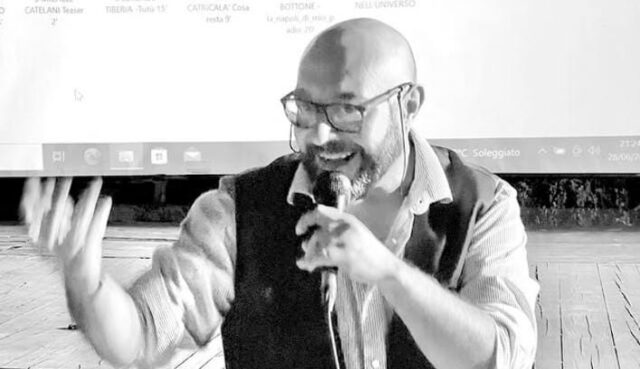
CINEMALBAR means film screenings outside movie theatres: at bars, cafes and pubs. This live event organized in not-strictly-cinematic places, is back for the season 2026-2027. Saverio Piunno, its organizer in the years of a deep cinema crisis, brought screenings closer to the audience. But what he does is always cinema meant as screenings of works by filmmakers from all over the world, meetings between authors, discussions, debates and a constant laboratory of creative ideas.
We as Paese Roma staff, dealing with cinema, thank CINEMALBAR for a meeting from which an entire series of independent feature films was born. That is why we would like to tell its story and promote it by interviewing for you today Saverio Piunno, the Cinemalbar founder.
Saverio, how was Cinemalbar born?
Cinemalbar was born in Bologna in 1999, at the time when I was attending University artistic studies called DAMS. The initial spark was my desire to make short films known, especially those made by us young DAMS students, to a wider audience.
It seemed a pity that so many interesting works remained confined within the university environment, known only to film students or professionals.
So I thought of taking them out of the university, into venues, bars and meeting places frequented also by students from other faculties and by people who did not necessarily have a professional relationship with cinema.
The surprising thing was that many did not even know that short film existed as an autonomous cinematic form. Through the screenings, they started discoverinh it, becoming passionate about it, following us.
It was nice to see how an audience completely extraneous to that world could become curious, excited and participate in discussions about the films.
Thus I understood: Cinemalbar could become something more than a simple showcase: a meeting space between those who make cinema and those who want to discover it.
How does it grow, develop, transform over time?
Cinemalbar has grown together with me, with the people I have met and with the changes in the audiovisual world. It is a project that has never had a definitive form, because it has always tried to interpret the present.
It started in Bologna, where it developed its initial identity and a network of filmmakers, artists and enthusiasts. Today it has arrived in Rome, where it has found new energy, new spaces and new people to speak to.
Over time, the meaning Cinemalbar has also changed. Today it is not only a showcase of short films: it is a multidisciplinary live event bringing together cinema, theater, music, visual arts, publishing and multimedia.
I like defining it a permanent laboratory of creativity. A place where a debut director, a professional actor, a writer, a musician, a student or simply a curious person can meet.
What interests me most is that concrete projects, collaborations and, why not, new films can be born from these meetings. Cinemalbar does not limit itself to showing what has been shot, it is a contribution to creating what has yet to be produced. Cinemalbar has grown together with experience, people and changes in the audiovisual world. It is a project that has never had a definitive form, because I have always tried to let it evolve.
From the first experience in Bologna we arrived in Rome, crossing different contexts, generations and cultural realities.
Cinemalbar has become a kind of permanent laboratory, where professionals, young authors, artists and people who simply want to participate meet.
Its transformation, frankly speaking, is already underway. It is not something I only imagine for the future: it is a process I try to launch at every appointment.
What differences do you feel between the filmmakers of Bologna and those of Rome, and between the filmmakers of when you started and those of today?
Bologna and Rome have two different cinema souls. Bologna has always conveyed to me a more intimate, experimental feeling, linked to research and cultural contamination. Rome, on the other hand, is a huge city, full of professionalism, experience, opportunities and contradictions. Here cinema is an industry, a tradition and a very strong collective imagination.
Of course I do not want generalizing: in both cities I have met extraordinary authors having, though, very different sensibilities and languages.
The most evident difference I perceive between the filmmakers of yesterday and those of today concerns the application of tools and of what a production system is.
When I started, making a film was a much more complex business from a technical and economic point of view. Today digital technology has greatly democratized production: being the tools relatively accessible, it is possible to create works of great quality.
But having a camera available does not automatically mean having something to tell.
Today I see a lot of energy, creativity and technical preparation, but also a certain difficulty in finding spaces for discussion, listening and growth. A lot is being produced, a lot – even too much – is being published, but it is not always possible to reach visibility and to build a community around one’s work.
It is precisely in this space that Cinemalbar tries to intervene: to create opportunities where works can meet people, ideas and other languages.
It is an initiative in which people participate for free. How do you manage to carry forward an initiative so useful to the community, but so challenging from an economic point of view?
This is probably one of the most difficult challenges. Cinemalbar is an independent project, and keeping it alive requires time, energy, organization and resources.
Free admission for me is a cultural choice even before an economic one. I believe culture, especially independent cinema made by young authors, must be accessible to everyone. I do not want someone to give up participating because they cannot afford a ticket.
Of course it means sacrifices and a continuous search for collaborations, available spaces, people who believe in the project and companies supporting it.
There is no economic structure behind Cinemalbar, there are no commercial interests. There is, above all, work of passion, relationships and planning.
I would like Cinemalbar to be able to find forms of support, through collaborations with institutions, associations, foundations and private entities sensitive to independent culture.
I believe such a project should not be considered just an event: it is a cultural service for the community.
What are the criteria with which you choose films to be shown to your audience?
The first criterion: a film has something to communicate. It does not necessarily have to be technically perfect or have an important production. I am interested, above all, in the expressive necessity behind a work.
I look for ideas, personal views, originality, narrative courage. I am interested in discovering authors who have their own identity, even when they use imperfect or experimental languages. I do not want to build a program based only on awards got, well-known names or trends of the moment.
Of course, technical quality and narrative ability are important, but they are not the only evaluation elements. Sometimes a small independent film manages to excite, provoke or open a reflection much more than a work made with important means.
I am also interested in variety: Cinemalbar must offer the audience the possibility of encountering different languages and sensibilities, coming from different experiences and countries.
Do you accept only short films or can an independent feature film also be sent to you for evaluation?
Absolutely yes, Cinemalbar is also open to independent feature films.
Short film has always had a central role in the project just because it allows to propose more authors and more stories within the same evening. But I do not want to place limits on the cinematic form.
An interesting independent feature film deserves attention and can find space within special appointments and screenings or specific moments of the programming.
What counts is the quality of the fipm proposed, its identity and the possibility of creating a significant encounter with the audience.
I, therefore, invite directors, authors and independent productions to submit their works to me. Cinemalbar wants to be an open door for those who do not easily find distribution circuits or visibility opportunities. It also wants to be a door for artists, actors, musicians, writers, technicians who want to create new synergies, especially with young debutants and emerging talents. In fact, I have added a subtitle “the live event mixing emerging talents and professionals of yesterday and today”.
What is the Cinemalbar audience like and how does it change over time?
The Cinemalbar audience is very multifaceted – and it is exactly what I love most. There are filmmakers, students, actors, industry professionals, film enthusiasts, artists and people who may not usually attend movie theaters or festivals. What I like most is when someone arrives without knowing anyone and ends the evening talking to a director, an actor or another viewer. Then I understand: Cinemalbar has achieved its goal.
Over time I have also noticed a generational turnover. There are people who have followed the project in its different phases and others who are discovering it for the first time.
Today the audience has very different viewing habits as compared to the past: we are used to seeing content on smartphones, on platforms, on social media. But precisely for this reason I believe it has become even more important to meet physically, watch a work together and discuss it.
The collective viewing is something that cannot be completely replaced by a personal screen.
Have you ever thought of making Cinemalbar a national or even international ion-the-road event?
It has already been in the past, and I hope it will be in the future. To date I have built a network of Cinemalbar in several Italian cities and in the world. But I prefer not to anticipate too much what it could become.
At the moment I am focused on the upcoming dates, meetings and programming for the autumn of 2026.
I believe every project must have time to mature and the most interesting transformations must be born from concrete experiences.
2027 will probably be an important year to think about new developments. For now I want to go on bring Cinemalbar to life in Rome, appointment after appointment, without losing the spirit with which it was born.
You are also a film director. How does managing Cinemalbar help or perhaps hinder your personal path as a filmmaker?
Managing Cinemalbar means dedicating a lot of time to others: watching shorts, selecting works, contacting authors, organizing meetings, finding spaces, taking care of communication and following every aspect of the event.
But there is also another side. Cinemalbar is for me a continuous training ground for observation and confrontation. I meet stories, languages, sensibilities and people who continuously pique my curiosity.
Listening to other authors allows me to question my ideas, to observe cinema from different perspectives and not to close myself in my individual path.
In some way, Cinemalbar has also become part of my artistic identity. I am not only the director who organizes it, but a person who believes in cinema as a shared experience and in the need to build spaces of creative freedom.
My challenge today is to find a balance: to go on giving space to others without giving up the need to tell my own stories as well.
Please tell us about the films you have shot/written and where we can see them.
This is a question I am particularly moved by, because behind Cinemalbar there is also my personal path as an author and director.
Over the years I have worked on films and audiovisual projects, crossing different experiences and languages. My relationship with cinema has always been linked to experimentation, storytelling and the possibility of using images to describe reality, but also to reinvent it.
My way of a director started in the same years as DAMS, when I had the desire to directly experiment with the language of Cinema.
Among the works I remember with greater interest there is “La Ragazza di Zagabria” (The Girl from Zagreb), a short movie shot on film (not digitally) in Italy and Croatia, an experience belonging to a period when making a film meant dealing with a technical and production reality that differed a lot from the current one.
Another project is “Qualcosa” (Something), an 80-minute comedy, made with a Canon XL1, always in those years. It is a work I am particularly attached to, even if it has never been released.
In those same years I also directed a documentary on the dancer Isadora Duncan, for the University of Bologna.
In the following years I shot videos in Molise Region (Italy), in Canada and directed the docu-short “The Barrel / La Botte”, for the International Wood Culture Society. Then I focused on writing my first feature film for the Cinema and I made a short promotional trailer “Uniti nell’Universo” (United in the Universe).
You may see my film production on the following YouTube links:
(1) Saverio Piunno – YouTube
http://www.youtube.com/@saveriopiunno2657
(1) saverio piunno – YouTube
http://www.youtube.com/@saveriopiunno3898
(1) Piunno Film – YouTube
http://www.youtube.com/@piunnofilm294
What goals do you set today for yourself and for your creature, Cinemalbar?
Today my goal is to make Cinemalbar grow without distorting its original spirit. I would like it to become a point of reference for young people and a meeting place between different artistic disciplines, capable of connecting people, ideas and experiences.
I would like to expand the network of collaborations, involve other cities and create concrete opportunities for production and distribution for independent authors, giving space and trust especially to young talents. I would like to contribute to the discovery and growth of a new generation of Italian directors, enhancing merit, creativity and passion.
But there is another goal I greatly care about: to go on bringing people together. In a world increasingly connected through screens, I believe it is important to meet in a physical space, watch a film, listen to an author and share ideas with him/her.
I do not know where Cinemalbar will arrive, nor do I want to establish it in advance. I would simply like it to go on growing remaining faithful to its origin: a desire to share cinema and the curiosity to discover what can be born from a meeting between people. Cinemalbar should remain an open place for those who have something to tell and are looking for an opportunity to do it.
Cinema as encounter, experience and creative possibility.
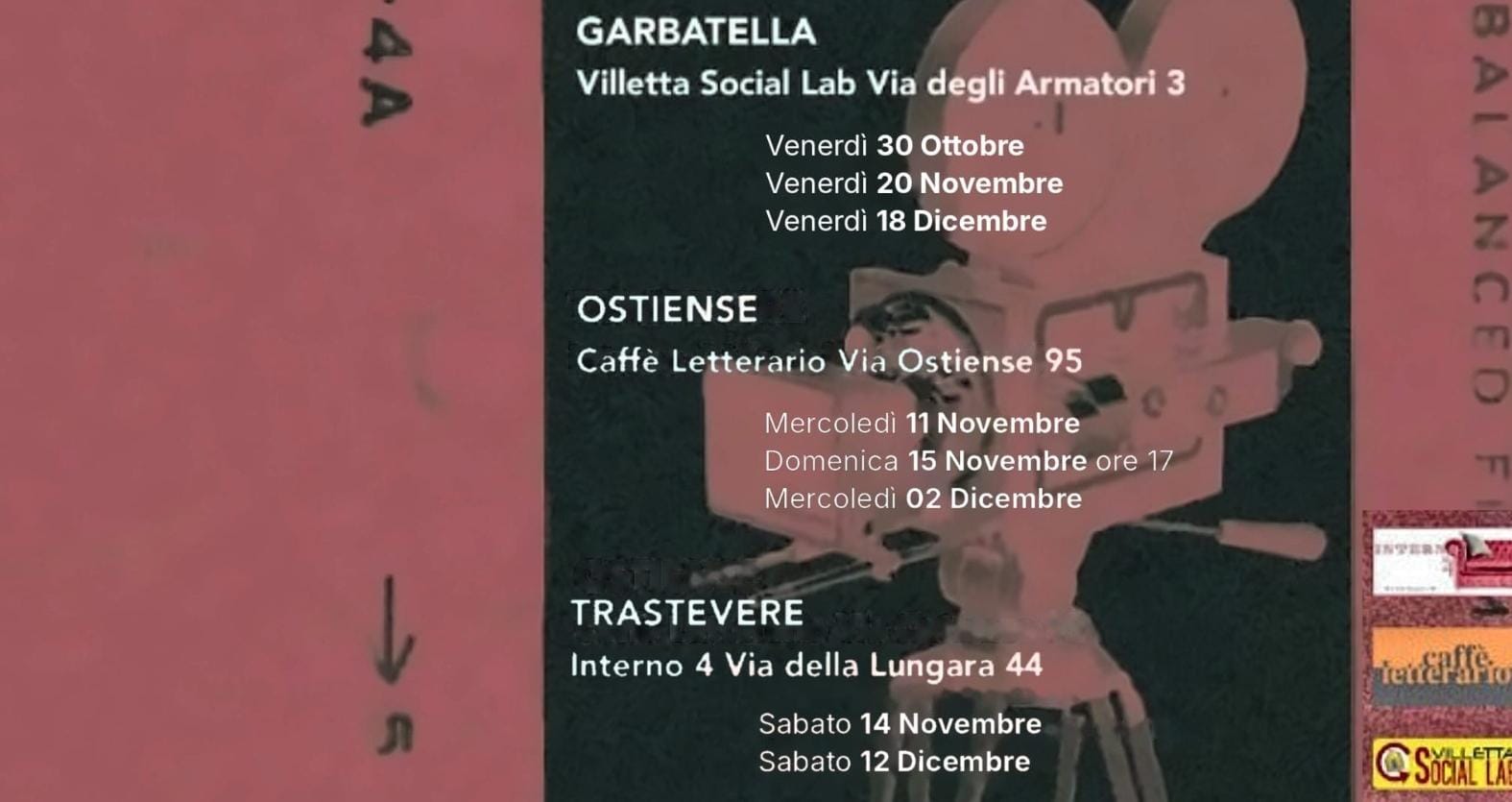
We wish Cibemalbar growth and prosperity, wish Saverio Piunno to surprise us with the films still to be directed. We invite all our readers to Cibemalbar whose next appointment is on November, 11th, at 8:00 p.m. at the Caffè Letterario located at via Ostiense 95 in Rome. For subsequent appointments, please, follow the Cinemalbar calendar poster.
Olga Matsyna