
Caffè della VerGOGNA – edizione del 21 Ottobre 2026
Una nota catena di sale cinematografiche ha introdotto una tariffa extra per chi vuole prenotare il seggiolino adiacente lasciandolo libero per borse e cappotti, e sul web è esplosa la bufera tra meme, ironia e boicottaggi organizzati dai cinefili. Tre euro per un posto vuoto: la trovata, che sembra una barzelletta, è invece il segno di un’epoca in cui ogni centimetro di spazio è diventato una voce di ricavo, e in cui persino il diritto di appoggiare una borsa accanto a sé viene monetizzato. Chi va al cinema per due ore di respiro dalla realtà scopre che anche lì, tra una reclame e l’altra, lo aspetta un listino.
Il tavolo di confronto tra esecutivo e sindacati sulla rimodulazione delle aliquote Irpef è saltato, e Cgil e Uil hanno annunciato lo sciopero generale autunnale. I sindacati accusano il governo di favorire i redditi alti e di scaricare il peso dell’inflazione sui lavoratori dipendenti, mentre la maggioranza difende la scelta di blindare i tagli contributivi. La riforma fiscale, che doveva essere la madre di tutte le riforme, si è arenata su un nodo elementare: chi paga il conto di una manovra che promette a tutti e non ha risorse per nessuno. I lavoratori dipendenti, che già sopportano l’Irpef più alta d’Europa, si ritrovano a finanziare una trattativa dove la loro voce è stata esclusa dal tavolo.
La Corte dei Conti e i ministeri competenti hanno congelato una tranche da ottocento milioni di euro destinata all’edilizia universitaria e ai laboratori di ricerca, a causa di gravi inadempienze e ritardi accumulati da diversi atenei del Centro-Sud. I rettori sono furiosi, i collettivi studenteschi pronti a mobilitarsi, e la vicenda, che sembra tecnica, racconta un Paese che non riesce a spendere i soldi che l’Europa gli ha dato. I laboratori restano chiusi, le aule cadono a pezzi, e i fondi del Pnrr, che dovevano trasformare l’Italia, si accumulano nei cassetti della burocrazia come un risparmio forzoso che nessuno ha chiesto.
L’Agenzia Internazionale per l’Energia ha diffuso un report che avverte: le tensioni geopolitiche nel Mediterraneo e i colli di bottiglia sulle rotte del gas liquefatto rischiano di far impennare le bollette del trenta per cento con l’arrivo dei primi freddi. Le associazioni dei consumatori hanno chiesto interventi strutturali sul tetto ai prezzi prima che la crisi diventi ingestibile, e la domanda che si ripete ogni autunno è sempre la stessa: perché un Paese che importa quasi tutta l’energia che consuma non ha ancora costruito una politica seria per ridurre la propria dipendenza? L’inverno arriverà comunque, e con lui le bollette.
In una grande area metropolitana, la polizia locale ha sequestrato cinquanta monopattini elettrici modificati artigianalmente, capaci di toccare i settanta chilometri orari sui marciapiedi e contromano. Multoni ai proprietari e nuove richieste di immatricolazione obbligatoria, e la vicenda, che fa sorridere per la fantasia dei truffatori, rivela un vuoto normativo che nessuno ha ancora colmato. I monopattini, che dovevano essere il simbolo della mobilità dolce, sono diventati un mezzo truccato capace di uccidere un pedone, e lo Stato, che li ha accolti senza regole, ora prova a rincorrerli con le multe.
Infine, un branco di cinghiali ha occupato stabilmente il parco acquatico di un complesso ricettivo fuori stagione, facendo il bagno nelle vasche idromassaggio e bloccando per ore l’intervento degli addetti alla fauna. Il video girato dal custode è diventato virale in poche ore, e la scena, per quanto comica, dice qualcosa di serio: gli animali selvatici hanno imparato a convivere con le nostre strutture meglio di quanto noi abbiamo imparato a convivere con loro, e le piscine vuote dei villaggi turistici, in autunno, diventano il loro territorio di conquista.
Il caffè della vergogna, stamattina, sa di seggiolini vuoti e di aliquote, di fondi congelati e di bollette in arrivo, di monopattini truccati e di cinghiali in idromassaggio. Il cinema fa pagare il posto accanto, i sindacati scioperano, gli atenei restano senza laboratori, l’Inverno porta rincari, i monopattini volano a settanta all’ora, e un branco di ungulati si gode la vasca. In fondo a quella piscina, tra le bolle spente e le sdraio capovolte, resta il segno del passaggio di chi non ha pagato il biglietto.
Karl Polanyi, La grande trasformazione, Einaudi, Torino, 1974
Amartya Sen, La diseguaglianza, Il Mulino, Bologna, 1992
Luciano Gallino, Finanzcapitalismo, Einaudi, Torino, 2011
David Harvey, La crisi della modernità, Il Saggiatore, Milano, 1993
Ivan Illich, Nemesi medica, Mondadori, Milano, 1977
Giorgio Agamben, Che cos’è un dispositivo?, Nottetempo, Milano, 2006
Anna Tsing, Il fungo alla fine del mondo, Keller, Rovereto, 2021
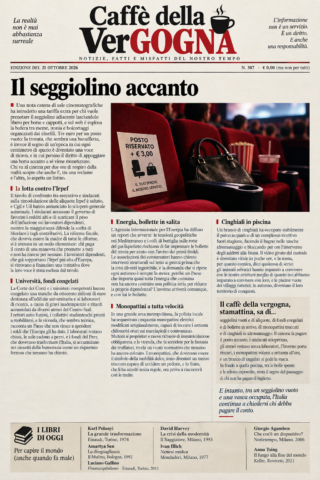
The Seat Next Door Caffè della VerGOGNA — October 21, 2026 Edition
A noted cinema chain introduced an extra fee for those wanting to reserve the adjacent seat, leaving it free for bags and coats, and on the web the storm exploded between memes, irony, and organized boycotts by cinephiles. Three euros for an empty seat: the gimmick, which seems like a joke, is instead the sign of an era in which every centimeter of space has become a revenue line, and in which even the right to rest a bag beside oneself is monetized. Whoever goes to the cinema for two hours of relief from reality discovers that even there, between one advertisement and the next, a price list awaits them.
The negotiating table between the executive and trade unions on reshaping IRPEF rates collapsed, and CGIL and UIL announced the autumn general strike. Unions accuse the government of favoring high incomes and unloading the weight of inflation onto salaried workers, while the majority defends the choice of locking in contribution cuts. The tax reform, which was supposed to be the mother of all reforms, ran aground on an elementary knot: who pays the bill of a maneuver that promises everything to everyone and has resources for no one. Salaried workers, who already bear the highest IRPEF in Europe, find themselves financing a negotiation where their voice was excluded from the table.
The Court of Auditors and the competent ministries froze an eight-hundred-million-euro tranche destined for university construction and research laboratories, due to grave failures and delays accumulated by several universities in the Center-South. Rectors are furious, student collectives ready to mobilize, and the affair, which seems technical, tells of a country that cannot manage to spend the money Europe gave it. Laboratories remain closed, lecture halls fall to pieces, and PNRR funds, which were supposed to transform Italy, accumulate in bureaucracy drawers like a forced saving no one asked for.
The International Energy Agency released a report warning: geopolitical tensions in the Mediterranean and bottlenecks on liquefied gas routes risk driving utility bills up thirty percent with the arrival of the first cold weather. Consumer associations requested structural interventions on price caps before the crisis becomes unmanageable, and the question repeating every autumn is always the same: why has a country that imports almost all the energy it consumes not yet built a serious policy to reduce its dependence? Winter will arrive anyway, and with it the bills.
In a large metropolitan area, local police seized fifty electric scooters hand-modified, capable of reaching seventy kilometers per hour on sidewalks and against traffic. Heavy fines to owners and new requests for mandatory registration, and the affair, which makes one smile for the scammers’ imagination, reveals a regulatory void no one has yet filled. Scooters, which were supposed to be the symbol of gentle mobility, have become a tampered vehicle capable of killing a pedestrian, and the state, which welcomed them without rules, now tries to chase them with fines.
Finally, a herd of wild boars has permanently occupied the water park of a resort complex in the off-season, bathing in the hydromassage pools and blocking for hours the intervention of wildlife handlers. The video shot by the caretaker went viral within hours, and the scene, however comic, says something serious: wild animals have learned to coexist with our structures better than we have learned to coexist with them, and the empty pools of tourist villages, in autumn, become their territory of conquest.
This morning’s coffee of shame tastes of empty seats and tax rates, frozen funds and incoming bills, tampered scooters and boars in the hot tub. Cinema charges for the seat next door, unions strike, universities remain without laboratories, winter brings price hikes, scooters fly at seventy per hour, and a herd of ungulates enjoys the pool. At the bottom of that pool, between the extinguished bubbles and the overturned lounge chairs, remains the sign of the passage of those who didn’t pay for the ticket.
Karl Polanyi, The Great Transformation, Einaudi, Turin, 1974 Amartya Sen, Inequality Reexamined, Il Mulino, Bologna, 1992 Luciano Gallino, Financial Capitalism, Einaudi, Turin, 2011 David Harvey, The Condition of Postmodernity, Il Saggiatore, Milan, 1993 Ivan Illich, Medical Nemesis, Mondadori, Milan, 1977 Giorgio Agamben, What Is an Apparatus?, Nottetempo, Milan, 2006 Anna Tsing, The Mushroom at the End of the World, Keller, Rovereto, 2021